
Head of the direction:
Scientific team:
- Shalygin Vadim Alexandrovich
- Vinnichenko Maxim Yakovlevich
- Panevin Vadim Yuryevich
- Melentyev Grigory Alexandrovich
- Kharin Nikita Yuryevich
- Ustimenko Ratmir Vladlenovich
- Karaulov Danila Andreevich
- Research directions
1. Semiconductor optoelectronics and nanoelectronics devices:
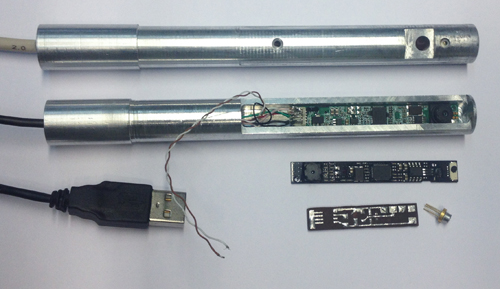
⇒ therapeutic-diagnostic dental laser complex (Patent 2015) and a complex for diagnostics, prevention and treatment of oncological diseases (Patents 2012, 2013)
⇒ terahertz-range lasers on hot holes in germanium (USSR State Prize, 1987)
⇒ high-speed IR and terahertz radiation modulators on hot charge carriers
⇒ mid-IR lasers and detectors based on nanoheterostructures with quantum wells and dots2. New optical and kinetic phenomena in semiconductors in strong electric fields under charge carrier heating, as well as in strong crossed electric and magnetic fields:
⇒ intraband and intersubband light emission by hot electrons and holes
⇒ intra- and interband light absorption by hot electrons and holes, including that induced by non-equilibrium optical phonons
⇒ Faraday and Kerr effects on hot electrons and holes in single-valley and multi-valley semiconductors
⇒ interband light absorption induced by non-equilibrium optical phonons
⇒ current-induced optical activity
⇒ photon drag by hole current in germanium
⇒ light interference under electron heating
⇒ population inversion of hot charge carriers and generation of far-IR (terahertz) range radiation.3. Optical phenomena in nanoheterostructures, related mainly to intraband (intrasubband and intersubband) transitions of non-equilibrium charge carriers in quantum wells, to intraband interlevel transitions of non-equilibrium charge carriers in quantum dots, and to the dynamics of light absorption and emission in nanostructures in the picosecond range:
⇒ far-IR (terahertz) range light emission and absorption during intra- and intersubband transitions of hot electrons and holes
⇒ light absorption and refraction under electron heating in quantum wells
⇒ photoluminescence of semiconductor nanowhisker nanocrystals
⇒ intraband light emission from quantum dots and quantum wells
⇒ circular photogalvanic effect on intersubband transitions in quantum wells4. Spin orientation by electric current
5. Physics of plasmon-polaritons in two-dimensional nanostructures
- Equipment used
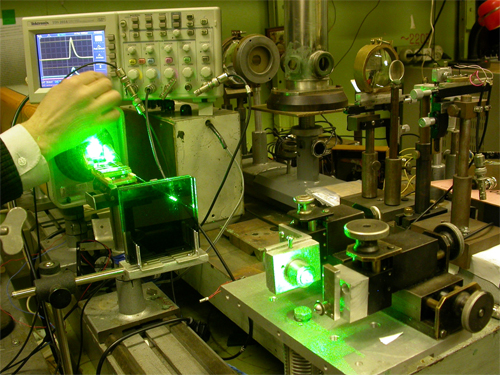
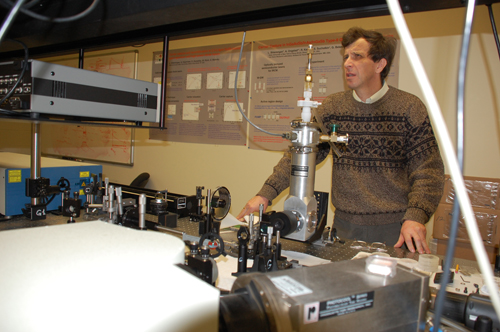
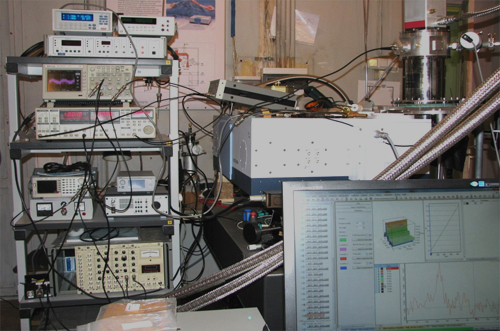
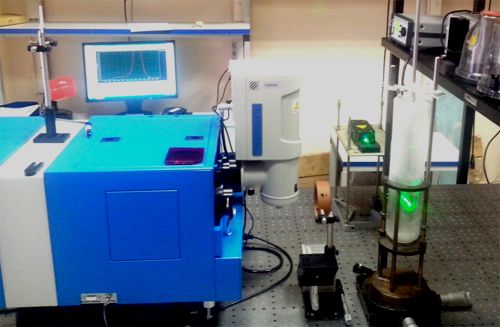
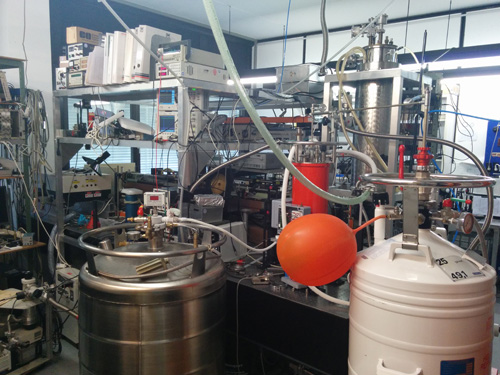
1. Vacuum broadband Fourier spectrometer Bruker Vertex 80v for the 0.5-1000 µm range – for studying absorption and emission spectra in the mid-IR, far-IR and terahertz ranges.
2. Photodetectors with amplifiers for the infrared and terahertz ranges (including a highly sensitive silicon bolometer for the terahertz range, cooled with liquid helium, and low-inertia detectors in a closed-cycle cryostat – Ge:Ga and a hot electron bolometer in InSb), necessary for detecting radiation in the far-IR, mid-IR and terahertz ranges.
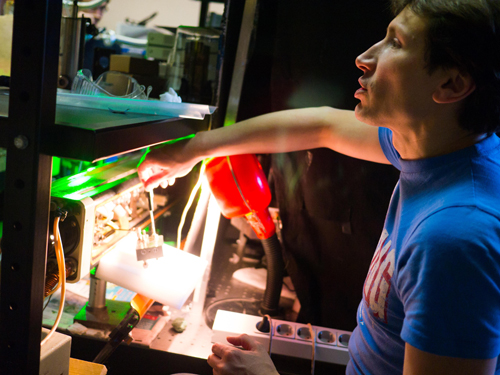
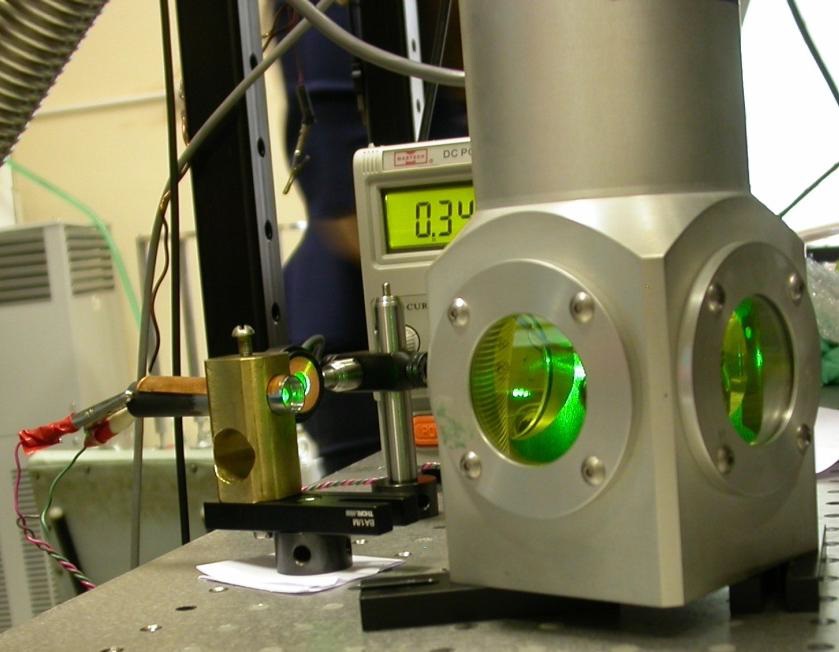
3. Pulsed YAG:Nd laser with frequency doubling, continuous-wave semiconductor lasers – for optical interband pumping of structures and creating non-equilibrium charge carriers.
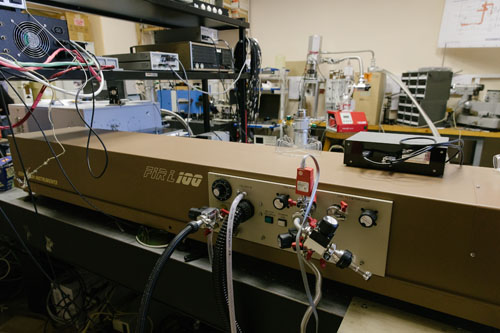
4. Continuous-wave terahertz laser on methanol vapor and a continuous-wave carbon dioxide laser for studying radiation absorption in the terahertz and IR ranges by free electrons.
5. Grating infrared spectrometer Horiba Jobin Yvon, necessary for characterizing samples via near-infrared photoluminescence spectra.
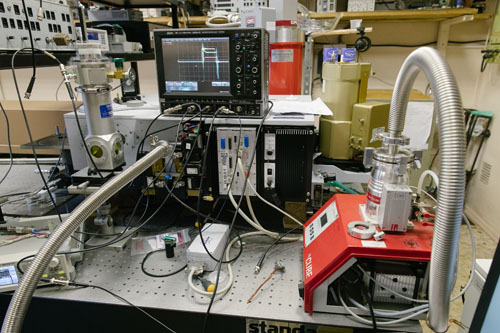
6. Oscilloscopes (including digital LeCroy WavePro 715 Zi, Tektronix TDS2014, Agilent Technologies DSO 6034), high-field pulse generators, power supplies, etc., necessary for measurements.
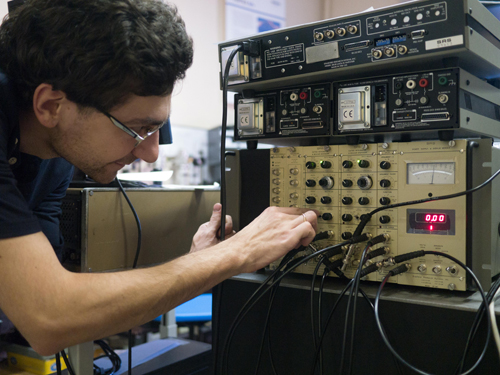
7. Phase-sensitive lock-in detectors (Lock-in amplifier) SR830 with SR570, SR560 current and voltage preamplifiers, necessary for recording weak output signals from photodetectors, as well as a Boxcar SR250 pulsed synchronous detector.
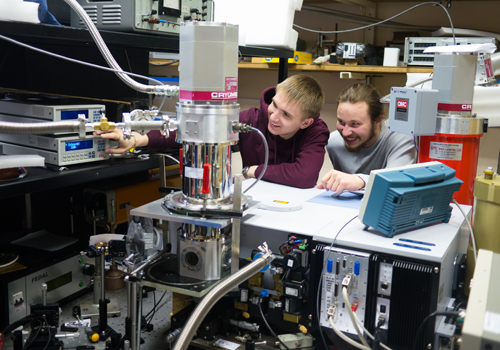
8. Closed-cycle cryostat Janis PTCM (T=4-350 K), for studying light absorption and emission from nanostructures at different temperatures.
- Publications
Publications can be viewed by following the links below:
- Achievements
1. The spectra of intraband photoinduced absorption of radiation in GeSi/Si quantum dots with different doping levels have been studied. Using time-resolved spectroscopy, characteristic times determining the detection process rate, associated with charge carrier capture and recombination processes, were found (R.V. Ustimenko, M.Ya. Vinnichenko, D.A. Karaulov, H.A. Sarkisyan, D.B. Hayrapetyan, D.A. Firsov. Effect of Doping and Interband Pumping on the Optical Properties of GeSi/Si Quantum Dot Nanostructures for Infrared Detectors. ACS Appl. Nano Mater. 7, 27245−27253 (2024). https://doi.org/10.1021/acsanm.4c05251 IF =5.5, Q1, Scopus).
2. The dependence of photoluminescence intensity on the angle between the radiation polarization vector and the direction of the applied longitudinal electric field in a GaAs layer has been discovered and studied. It is shown that such anisotropy is caused by the simultaneous action of two factors: anisotropic deformation of the electron distribution function in k-space and the angular dependence of the interband optical matrix element. Electron and hole temperatures as a function of the electric field were determined (V.A. Shalygin, I.S. Makhov, R.B. Adamov, M.Ya. Vinnichenko, V.P. Khvostikov, D.A. Firsov. Electric-field-induced polarization anisotropy of interband photoluminescence in GaAs. Journ. of Appl. Phys. 136(19), 195703 (2024). https://doi.org/10.1063/5.0233573 IF 2.7, Q2, Scopus).
3. The hypothesis about the increase in impurity terahertz emission intensity upon spatial separation of donors and acceptors in GaAs/AlGaAs quantum wells has been experimentally confirmed. Terahertz emission occurs upon capture of photoexcited non-equilibrium electrons from the conduction band into impurity states (R.B.Adamov, G.A.Melentev, I.V.Sedova, S.V.Sorokin, G.V.Klimko, I.S.Makhov, D.A.Firsov, V.A.Shalygin. Terahertz photoluminescence in doped nanostructures with spatial separation of donors and acceptors. Journal of Luminescence. Volume 266, February 2024, 120302. https://doi.org/10.1016/j.jlumin.2023.120302 IF 3, Q2, Scopus).
4. Photoluminescence (PL) in nanowhisker nanocrystals (NWs) based on pure InAs and heterostructured InAs/InP core-shell NWs has been studied in detail. Using PL spectra, it was shown that NWs form in the wurtzite-sphalerite polytypic phase. It was shown that shell thickness inhomogeneity drastically affects the radiative recombination mechanism in InAs/InP NWs (V.Fedorov, M.Vinnichenko, R.Ustimenko, D.Kirilenko, E.Pirogov, A.Pavlov, R.Polozkov, V.Sharov, A.Kaveev, D.Miniv, L.Dvoretckaia, D.Firsov, A.Mozharov, I.Mukhin. Non-uniformly strained core-shell InAs/InP nanowires for mid-infrared photonic applications. ACS Appl. Nano Mater. 6(7) 5460-5468 (2023). https://doi.org/10.1021/acsanm.2c05575 IF =5.5, Q1, Scopus).
5. Optical transitions in an asymmetric biconvex lens-shaped InAs quantum dot in an external magnetic field have been theoretically studied using analytical methods. It was shown that temperature and magnetic field significantly affect the optical properties of the nanostructure under consideration (M.A. Mkrtchyan, D.B. Hayrapetyan, E.M. Kazaryan, H.A. Sarkisyan, M.Ya. Vinnichenko, V.A. Shalygin, D.A. Firsov and L.S. Petrosyan. Effect of an External Magnetic Field on the Interband and Intraband Optical Properties of an Asymmetric Biconvex Lens-Shaped Quantum Dot. Nanomaterials 12(1), 60 (2022). https://doi.org/10.3390/nano12010060 IF 5.435, Q1, Scopus.).
6. A microscopic theory of the current-linear and light-wave-vector-linear change in the refractive index of a structure with quantum wells in the spectral region of intersubband light absorption has been developed. The phenomenon was experimentally discovered and studied for the first time (G.V.Budkin, I.S.Makhov, D.A.Firsov. The drag of photons by electric current in quantum wells. J. Phys.: Condens. Matter 33(16), 165301 (2021). https://doi.org/10.1088/1361-648X/abdff7 IF 2.750, Q1, Scopus).
7. Experimental studies and model calculations of terahertz radiation transmission through a 4H-SiC plate have been performed. Lifetimes and oscillator strengths of transverse folded acoustic phonons were determined (V.A. Shalygin, R.B. Adamov, M.D. Moldavskaya, M.Ya. Vinnichenko, D.A Firsov. Far-infrared spectroscopy of folded transverse acoustic phonons in 4H–SiC. Applied Physics Letters, 117 (20), 202105 (2020). https://doi.org/10.1063/5.0031064 IF 3.808, Q1, Scopus.).
8. Equilibrium spectra of intraband absorption of polarized light in GaAs/AlGaAs quantum wells doped with acceptors have been studied theoretically and experimentally. Features in the absorption spectra are associated with optical transitions involving impurity states. Their spectral position is in good agreement with calculations using the finite difference method for quantizing the Luttinger-Kohn Hamiltonian. (M.Ya.Vinnichenko, I.S.Makhov, V.Yu.Panevin, L.E.Vorobjev, S.V.Sorokin, I.V.Sedova, D.A.Firsov. Acceptor-related infrared optical absorption in GaAs/AlGaAs quantum wells. Physica E: Low-dimensional Systems and Nanostructures 124, 114301 (2020). https://doi.org/10.1016/j.physe.2020.114301).
9. Stimulated emission of mid-IR quantum cascade lasers was experimentally obtained for the first time in Russia. This result was achieved within a large collaboration, with the contribution consisting of developing the methodology and directly experimentally detecting and studying spontaneous and stimulated emission from quantum cascade laser samples, starting from simple four-cleaved samples to samples with strips of various geometries and different growth technologies (A.V.Babichev, D.A.Pashnev, A.G.Gladyshev, D.V.Denisov, G.V.Voznyuk, L.Y.Karachinsky, I.I.Novikov, M.I.Mitrofanov, V.P.Evtikhiev, D.A.Firsov, L.E.Vorob’ev, N.A.Pikhtin, A.Y.Egorov. Quantum-Cascade Lasers with a Distributed Bragg Reflector Formed by Ion-Beam Etching. Technical Physics Letters 46(4), 312-315 (2020). https://doi.org/10.1134/S1063785020040033 IF 1.012, Q3, Scopus).
- Collaborations
Domestic partners:
- Ioffe Institute
- Institute for Physics of Microstructures RAS
- Academic University named after Zh.I. Alferov
- NM-Tech LLC
- Tidex LLC
- Scientific and Technological Equipment JSC / SemiTEq
- Svetlana-Rost JSC
- Semiconductor Devices JSC
Foreign partners:
- Russian-Armenian University (Armenia),
- Karshi State University (Uzbekistan).